
In the world of surfing and boardsports, some stories feel like founding myths. The story of Quiksilver belongs to this category: the tale of a small idea born on an Australian coast that became one of the most powerful symbols of global surf culture, before expanding to the mountains and the pavement, from snowboarding to skating.
For over fifty years, Quiksilver has supported the most talented surfers, snowboarders, and skaters on the planet, while profoundly influencing the aesthetic, technical, and cultural codes of boardsports.
The spirit of adventure at the heart of Quiksilver
From the very beginning, Quiksilver has embodied the essence of surf culture: a thirst for adventure, the quest for the perfect wave, and a visceral link with the ocean. Born from Alan Green and John Law’s idea to create the ideal boardshort for surfers, the brand answered a very concrete problem: in the late 1960s, classic swimwear chafed, ripped, and restricted movement.
From this frustration came an innovation that would tip the scales of the surfwear industry, proving that authentic passion—guided by a clear vision and attention to detail—could transform a practical need into a global empire without denying the free spirit of surfing.
It all started in Torquay in 1969
The Quiksilver story began in 1969 in Torquay, on Australia’s Surf Coast, a hotbed of surf culture. In a holiday home transformed into a workshop, Alan Green and John Law launched the brand.
While surfing was exploding in popularity, classic swim shorts weren’t keeping up: designed for lounging on the beach, they tore and hindered movement in powerful waves. Green, already involved in wetsuit manufacturing and close to the pioneers of the sport, saw a clear opportunity: to create clothing designed by surfers, for surfers, entirely dedicated to performance.
The duo adopted an ultra-pragmatic approach: observe what happens in the water, listen to surfers, test and re-test every prototype. This “function first” philosophy would become Quiksilver’s DNA.
The boardshort that changed everything
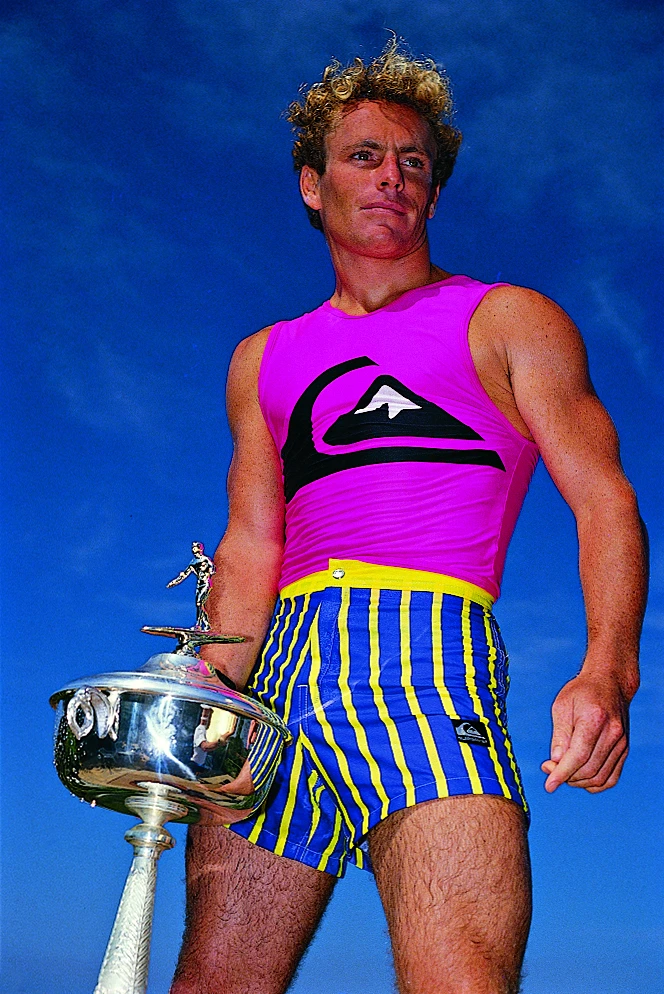
The first Quiksilver boardshort represented a technological breakthrough. Where classic swim shorts ballooned, lost their shape, and caused irritation and discomfort, the Quiksilver boardshort was designed as a true piece of technical equipment.
Innovations were numerous for the time:
- A Velcro fly, safer and more functional than traditional laces.
- Reinforced metal snaps to prevent accidental opening.
- A specific cut, with scalloped legs designed to free up movement.
- Reinforced stitching at stress points to withstand repeated wipeouts.
The choice of materials was equally strategic: quick-drying fabrics, resistant to salt, sand, and sun, capable of holding their shape session after session. Very quickly, these boardshorts were noticed in the line-up, worn by the best surfers of the era, notably figures like Mark Richards or Gerry Lopez, who helped popularise the brand on the globe’s most mythical spots.
This signature product didn’t just make sessions more comfortable: it redefined the global standard for surfwear. The technical boardshort became the norm, and Quiksilver established itself as the natural reference for demanding surfers.
Athletes turned legends
Quiksilver’s lightning success in Australia was only the first step in a spectacular international expansion. From the 1970s and 80s, the brand structured itself to conquer key markets: the USA, Europe, and then the rest of the world.
Conquering the American market, particularly Californian and Hawaiian spots, represented a turning point. By sponsoring some of the world’s best surfers, Quiksilver ensured maximum visibility on the Championship Tour and in surf films. Among the major figures associated with the brand, we find:
- Tom Carroll, double world champion (1983, 1984) and the first surfer to sign a major contract with Quiksilver, helping to usher surfing into a new professional era.
- Kelly Slater, eleven-time world champion, long-time emblem of Quiksilver and multiple winner of Quiksilver Pro events.
- Later, iconic free surfers like Dane Reynolds or Mikey Wright, whose style and video parts would leave a lasting mark on the surf community’s imagination.
- Robby Naish, a legendary boardsports figure and long-standing ambassador, whose career across surfing, windsurfing and kitesurfing helped extend Quiksilver’s influence well beyond traditional surfing.
In Europe, the foothold was just as strong, with strategic bases in France, Spain, and Portugal, and a particularly solid anchor on the Landes and Basque coasts. Surfers like Jérémy Flores, one of the great figures of European surfing, became famous ambassadors for Quiksilver.
In parallel, the brand progressively expanded its offer: wetsuits, technical apparel, accessories, and then, via sister brands like Roxy and DC Shoes, a reinforced presence in women’s surfing and skating.
More than a brand, a state of mind
Quiksilver’s influence quickly went beyond the product itself to touch boardsports culture as a whole. The brand didn’t just equip surfers; it helped define the aesthetic, values, and ambitions of an entire generation of riders.
This influence is expressed through:
- Cult films and video series, such as Moments or numerous surf and snow projects featuring Kelly Slater, Dane Reynolds, Craig Anderson, Jérémy Flores, Travis Rice and other team talents.
- The organisation of major events, innovative competitions, and festivals blending surf, music, and art.
- Deep work on storytelling, with documentaries dedicated to its surfers, like those focusing on Tom Carroll or Jérémy Flores.
The guiding line remains authenticity: Quiksilver doesn’t try to plaster artificial storytelling onto the surf community. The brand follows the movement, draws inspiration from it, and gives it tools and visibility. It is this proximity to riders—pros and amateurs alike—that creates a lasting emotional bond.
Quiksilver and snowboarding : from waves to mountains
When Quiksilver turned to snowboarding, the transition felt almost natural. It was no longer the ocean, but the mountain; yet, the philosophy remained the same: to ride, to draw your own line, to push your limits.

From the 1990s, the brand developed ranges dedicated to snowboarding: jackets, trousers, technical layers, and accessories designed to handle cold, wind, slams, and big powder days. These collections quickly established themselves on ski slopes and in snowparks.
One of the most iconic figures in this history is Travis Rice, considered one of the greatest snowboarders of all time. Quiksilver accompanied him in projects that redefined the standards of modern snowboarding, from ultra-high-production films to the creation of the Natural Selection Tour, a circuit blending freestyle and big mountain in spectacular locations.
Around Travis Rice, a solid snow team was built, with riders like Todd Richards, Miles Fallon or Bryan Fox highlighted in productions shot in North America with the Quiksilver team.
Alongside snowboarding, Quiksilver also hit the slopes in freeride skiing. The brand notably supported Frenchman Candide Thovex, considered one of the best skiers of his generation, for nearly two decades. From his cult segments in Quiksilver-backed films to his backcountry exploits, Candide helped durably associate the Quiksilver name with top-level skiing, alongside the planet’s greatest snowboarders.
In the mountains as in the ocean, Quiksilver applies the same recipe: support athletes capable of pushing the limits of their discipline, document their exploits, and translate these experiences into high-performance technical products.
Quiksilver and Skate : the rise of urban culture
Quiksilver’s entry into skating followed a logical continuity: after waves and snow, concrete became a new playground. Here again, the brand relied on iconic figures to assert its legitimacy.
Among them, one name dominates: Tony Hawk. One of history’s most famous skaters became a Quiksilver ambassador and participated in spectacular events, including the Quiksilver Tony Hawk Show organised at the Grand Palais in Paris to celebrate the brand’s 40th anniversary. The event brought together over thirty surf, skate, and snow team members, as well as renowned skaters like Andy McDonald, Kevin Staab, Jesse Fritsch, Sergie Ventura et Sandro Dias.
Through these collaborations, Quiksilver positioned itself as a transversal player in boardsports, capable of uniting surf, snow, and skate culture within a single universe. The association with Tony Hawk, a figure known far beyond skating thanks to his exploits and pop culture impact, allowed the brand to reach an audience much wider than just practitioners.
This presence in skating was reinforced by the group’s ecosystem, which also integrated DC Shoes, a global reference in skate footwear.
What is Quiksilver’s legacy today?
More than fifty years after its creation, Quiksilver remains an undeniable reference in surfing, snowboarding, and skating. The brand’s legacy is not limited to its products: it is read in the way boardsports are perceived, lived, and told around the world.
Several key elements summarise this legacy:
- Textile innovation, from the revolutionary boardshort of the 1970s to current technical equipment.
- A pioneering role in the surf professionalisation, with historic contracts like Tom Carroll’s or the long collaboration with Kelly Slater.
- Highligting local and international figures (from Jérémy Flores in Europe to Travis Rice in the mountains) who have inspired entire generations of riders.
- A strong brand culture, fuelled by films, competitions, festivals, and events blending sport, art, and music.
Facing contemporary challenges (environment, social responsibility, sustainability) Quiksilver is now working to combine heritage with adaptation. The ocean and the mountain are no longer just playgrounds: they are ecosystems to protect. The spirit of innovation that guided Alan Green and John Law in Torquay in 1969 remains an essential asset for continuing to evolve the brand in this new context.
FAQ – Your questions about Quiksilver story
Who founded Quiksilver and when?
Quiksilver was founded in 1969 by two Australian surfers, Alan Green and John Law, in Torquay, on the Surf Coast of Victoria, Australia.
What was Quiksilver’s first major innovation?
Quiksilver’s first major innovation was a technical boardshort specifically designed for surfing, featuring a Velcro fly, reinforced snaps, and a scalloped cut designed for performance, which redefined surfwear standards in the 1970s.
What does the Quiksilver “Mountain and the Wave” logo mean?
The “Mountain and the Wave” logo is inspired by Hokusai’s famous woodblock print The Great Wave off Kanagawa. It symbolises the duality between the power of the ocean (the wave) and the quest for peaks and achievement (the mountain), unifying surf, snow, and the spirit of adventure.
Who are the most iconic athletes on the Quiksilver team?
Among the most iconic riders associated with Quiksilver over the decades are:
Surf: Tom Carroll, Kelly Slater, Jérémy Flores, as well as free surfers like Craig Anderson and Dane Reynolds.
Snow: Travis Rice and a generation of riders highlighted in projects like Sequencer.
Skate: Tony Hawk, who signed several significant collaborations with Quiksilver.
These athletes have largely contributed to building the Quiksilver legend and making the brand an unavoidable symbol of global boardsports culture.