
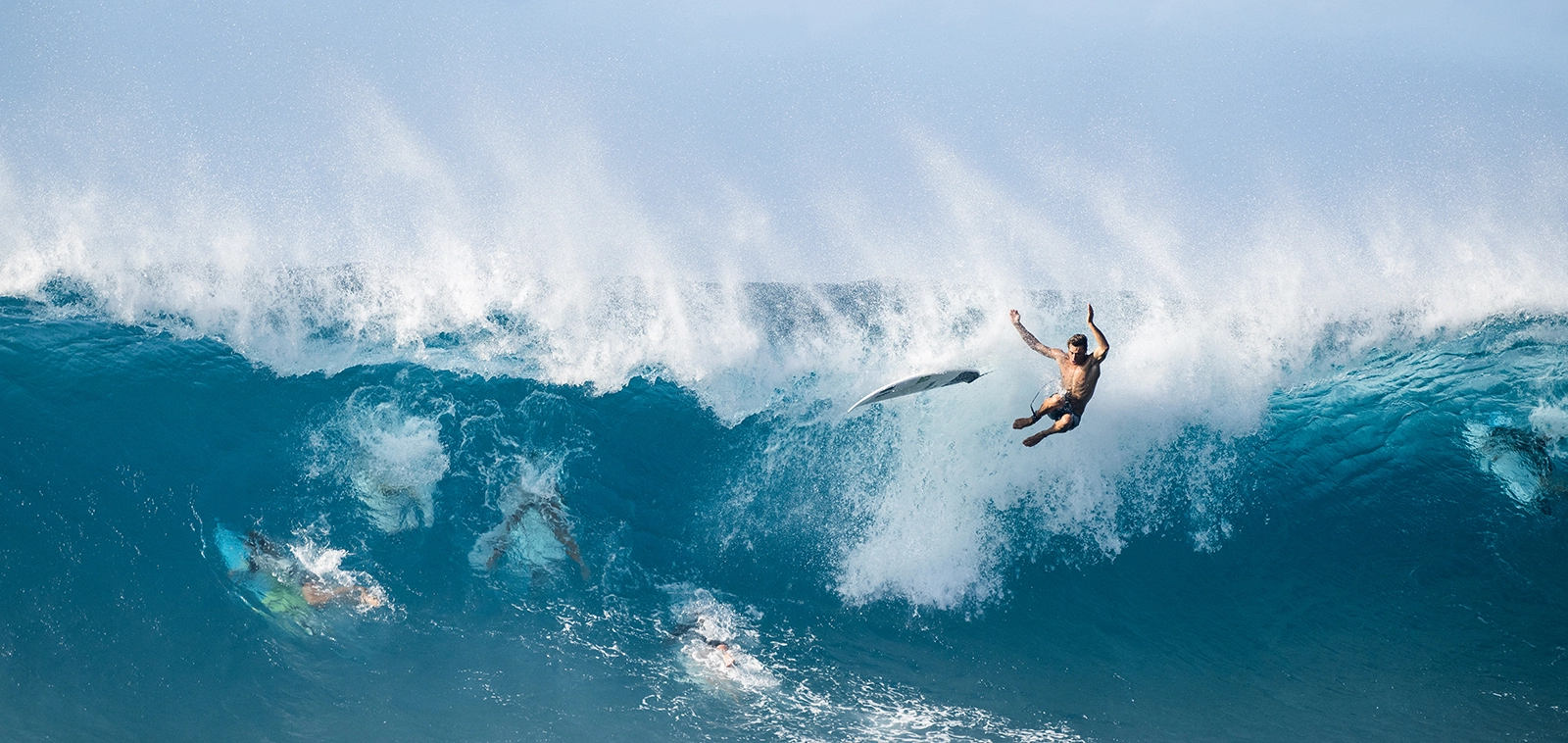
The take-off is the decisive moment that transforms a surfer from paddling prone to riding upright. This fundamental transition dictates the quality of your ride and determines your overall progression. Mastering this technique requires patience, practice, and above all, a precise understanding of every movement. This guide takes you through a step-by-step process to perfect your take-off and build your confidence in the water.
Preparation : before you even start paddling
Success begins with solid preparation. Before you even lie down on your board and start your paddle, several crucial elements must be considered to maximise your chances of a clean pop-up.
Choosing the right wave to start with
Wave selection heavily influences take-off success, especially for improving surfers. Aim for waves with a progressive slope and moderate speed, which give you enough time to stand up without rushing. Waves that are too fast or lacking in power make the movement unnecessarily difficult. Taking the time to observe the sets allows you to identify more regular and predictable waves, which are often more effective for learning than a larger, messier swell.
Finding the ideal placement on your board
Correct positioning on the board facilitates a smooth and controlled take-off. Your hands should be placed flat, level with your chest and aligned with your shoulders to generate an effective push. Keep your body centred on the stringer, with your feet together and aligned to preserve balance. Keeping your head slightly up allows you to anticipate the wave and maintain a stable posture from the very start of the movement.
The take-off technique : broken down into 3 key steps
The take-off can be deconstructed into three distinct and complementary phases. Each stage has its own technical specificities and should be mastered individually before being integrated into one fluid, harmonious motion.
Step 1 : Effective paddling to build speed
Paddling is the engine of your take-off. It must be powerful, steady, and perfectly synchronised with the wave’s energy. Begin paddling as soon as you feel the wave approaching, adopting a sustained but controlled rhythm.
Your arm strokes should be wide and deep, using the entire surface of your hands like paddles. Alternate regularly between left and right while maintaining a constant tempo. The goal is to reach the critical speed that allows the wave to pick you up.
Feel the surge of the wave beneath your board. When the water begins to carry you and you feel a natural acceleration, that is your signal that you have reached the necessary speed. Your board is now gliding with the wave rather than fighting against it.
Continue paddling for a few extra seconds to confirm you have caught the wave, then mentally prepare for the next step. This transition between paddling and the initial push is a key moment where focus is paramount.
Step 2 : The “push-up”, the move that changes everything
The push-up is the explosive phase that allows you to lift your chest off the board. Place your hands firmly flat on the deck, aligned with your shoulders, and push vigorously to straighten your arms.
This movement should be sharp yet controlled. Use the strength in your arms and shoulders to create the necessary space for your legs to swing through. Keep your eyes fixed forward, looking in the direction you want to travel on the face of the wave.
During this phase, keep your legs extended and together. Resist the temptation to drop your knees or rush the next move. The push-up must be complete and well-defined to create the optimal conditions for the final phase.
Timing with the wave remains essential: not too early when it lacks power, and not too late when it is already starting to break. Feel for the moment the slope steepens and the acceleration is confirmed.
Step 3 : The “pop”, standing up with fluidity and balance
The pop-up is the culmination of your take-off. In one fluid and coordinated motion, bring your feet under your body by tucking your legs, then gradually rise into a standing position.
Your feet should land on the board simultaneously, perpendicular to the stringer. Your back foot should be positioned roughly over the fins, while your front foot lands closer to the centre of the board. This stance provides the stability needed to maintain your balance.
Keep your knees slightly bent to absorb any bumps in the wave and use your arms for balance. Your gaze should be directed where you want to go, already anticipating your first turns.
Fluidity comes with practice. In the beginning, focus on precision rather than speed. A slow but well-executed pop-up is far better than a rushed movement that leaves you off-balance.
Take-off Timing
Common mistakes and how to fix them
Popping up too early or too late : a matter of timing
Timing is the linchpin of the take-off; it dictates your speed and stability from the very first second. Two errors frequently crop up:
- Too early: The wave isn’t carrying you yet, and the board lacks the necessary momentum.
- Too late: You end up taking off in the “whitewash” (the foam), where you have very little control.
You will recognise the “sweet spot” by two distinct physical cues: a clear acceleration of the board and a firm surge of the wave beneath your body. With experience, reading the ocean becomes natural and intuitive.
Putting your knees on the board : the “false friend”
Dropping to your knees might feel safer, but it is a habit that will seriously stall your progression. This intermediate step leads to:
- A significant loss of speed.
- A slower overall movement.
- A compromised centre of gravity.
The goal is clear: transition directly from a prone position to standing. To achieve this, practising the movement on dry land (beach drills) is the most effective method.
Looking at your feet instead of the wave
Looking down at your feet during the take-off is a common reflex, but it’s highly counter-productive. This habit:
- Throws the body off-balance.
- Prevents you from anticipating your line of travel.
The correct habit is to keep your gaze fixed forward, projecting yourself in the direction you want to glide. Foot placement should be felt, not seen. With practice, it becomes an automatic response that requires no visual check.
Training out of the water for a perfect take-off
Practising the movement on the sand
Beach drills allow you to repeat the take-off without the unpredictability of the ocean. Lie on your board and replicate the steps of the movement, focusing on hand placement, foot landing, and the fluidity of the transition. Start slowly, then gradually increase your speed until the movement is muscle memory, freeing up your mental focus for when you’re actually in the line-up.
Core and strength exercises for better stability
Physical conditioning is vital for a snappy take-off. Strengthening your core and upper body through planks and push-ups will give you the explosive power needed for the “push-up” phase. Better stability on land directly translates to a more controlled ride on the water.
FAQ – Your questions about the surf take-off
How long does it take to master the take-off?
Mastery varies for every surfer, but it generally takes several weeks of regular practice. While you might nail your first few in the opening sessions, making the movement instinctive requires patience and repetition.
Can I learn the take-off on any type of board?
Longer, wider boards (longboards or “foamies”) make learning much easier due to their increased stability. Shortboards require far more precision and are generally recommended once the basics are firmly established.
What should I do if I can’t stand up fast enough?
Focus on your physical fitness and practice the movement on dry land. A lack of explosive strength or a slight technical flaw is usually the culprit.
How do I know if I’m popping up at the right time?
You should feel the wave “catch” you and naturally accelerate your board. If you are still paddling hard to maintain speed, it’s too early. If the wave is already breaking around you, it’s too late.