
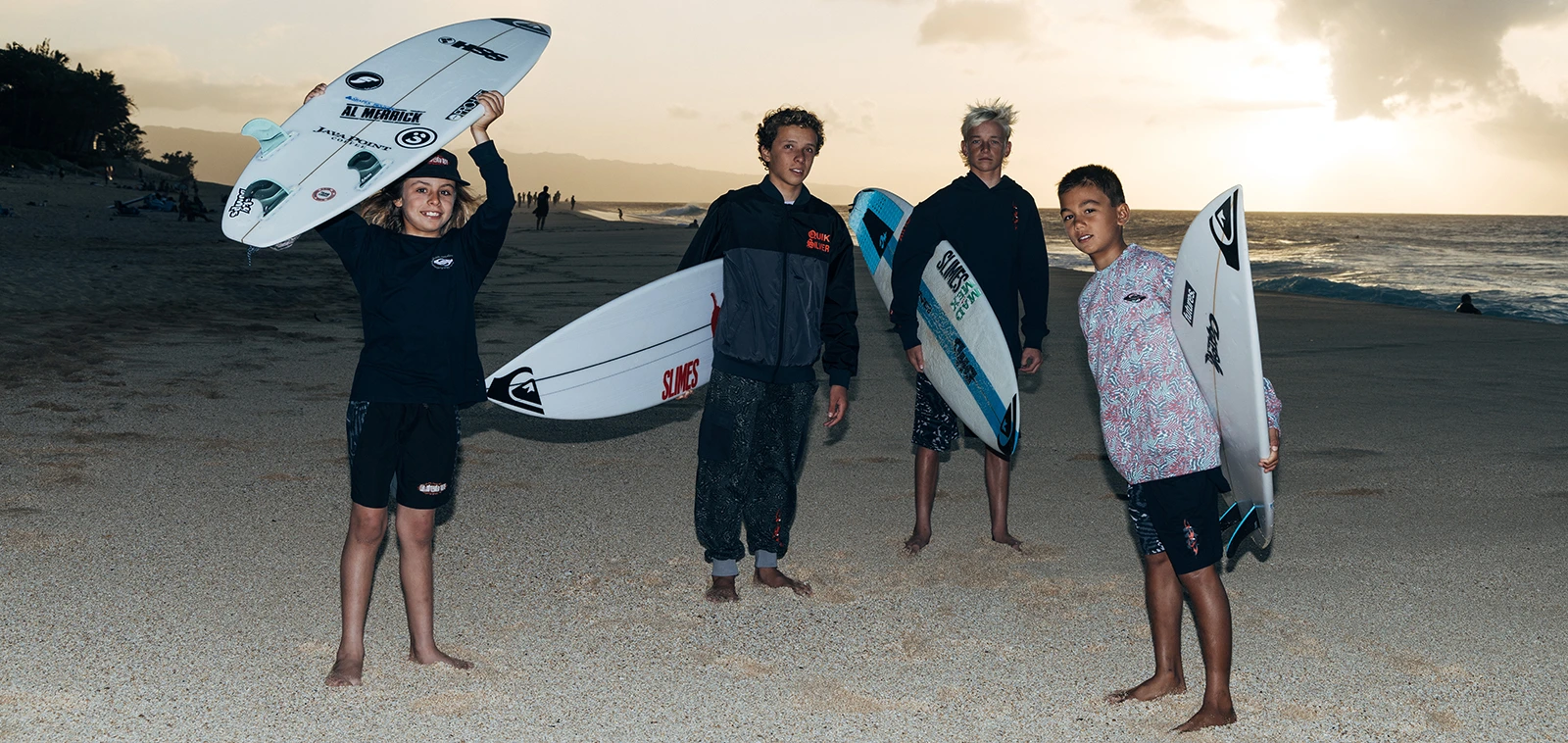
Introducing your child to surfing is about much more than just learning a sport. It is about offering them a unique connection with the ocean, building their self-confidence, and passing on values of respect for nature. Discover how to support your young surfer on this extraordinary adventure, from their first steps on the sand to the joy of gliding down the face of a wave.
What are the benefits of surfing for children?
Developing self-confidence and a bond with nature
Surfing literally transforms children. It teaches them to tame their fears while developing unshakable confidence in their abilities. Every wave conquered becomes a personal victory that boosts their self-esteem.
The ocean also offers an incomparable playground for awakening environmental awareness. Young surfers naturally develop a deep respect for nature, understanding the importance of preserving marine ecosystems. This privileged connection with the environment forges responsible citizens who are sensitive to ecological issues.
Surfing also teaches emotional management. Faced with the power of the ocean, children learn to channel their stress, remain calm in adversity, and transform apprehension into determination. These emotional skills will serve them throughout their lives, far beyond their surf sessions.
Learning patience and respect for the ocean
The ocean cannot be ordered around, and that is precisely what makes it an exceptional teacher. Children quickly understand that they must know how to wait for the right wave, observe the conditions, and respect the natural elements. This lesson in patience contrasts sharply with our era of instant gratification.
Respecting priority rules in the water also teaches manners and courtesy. Young surfers learn to share space, respect other water users, and understand the importance of fair play. These social values extend far beyond the context of surfing.
Observing weather and ocean conditions develops their analytical skills and ability to adapt. Children learn to read nature, anticipate changes, and make informed decisions for their own safety.
Is your child ready to jump in?
The ideal age to start : Beyond the numbers
Contrary to popular belief, age is not the only determining factor. While most surf schools welcome children from 6 years old, some 4 or 5-year-olds who are particularly comfortable in the water can already start with adapted supervision.
The key lies in the child’s emotional maturity. They must be able to listen to instructions, manage their emotions when facing waves, and clearly communicate how they feel. An anxious or fearful child will need more time to develop this necessary confidence.
Personal motivation trumps age. A passionate 7-year-old will progress faster than an unmotivated teenager. Observe your child’s spontaneous interest in water activities and their curiosity about surfing before making your decision.
Essential prerequisites before the first wave
Knowing how to swim (Non-negotiable)
- Swim at least 25 metres without assistance.
- Stay afloat in case of a fall (treading water).
- This is the indispensable baseline for their safety and confidence.
Being comfortable in the water
- Accepting water on the face without panicking.
- Being able to open eyes underwater.
- Staying calm when a wave washes over them.
- These reflexes can be practised in a swimming pool or calm sea.
Having good general physical condition
- Active play prepares the body and facilitates early progress on the board.
- Balance, coordination, and endurance are all engaged in surfing.
- Useful pre-surf activities: Skateboarding, gymnastics, running on the beach, aquatic games.
How to kit out your young surfer
The foam board : an absolute must
Foam boards (or “foamies”) have revolutionised learning to surf for kids. Their soft construction eliminates the risk of injury from impact, allowing young beginners to learn without fear. These boards also offer excellent buoyancy, making it much easier to catch waves.
Regarding size, choose a board that reaches your child’s chin when they are standing up. A board that is too big will be hard to manoeuvre, while one that is too small won’t offer enough stability. Models between 6’6 and 8 feet generally suit children aged 6 to 12.
Width plays a crucial role in stability. Wide boards (21-22 inches) offer more stability for learning, even if they are less manoeuvrable. Your child can move on to narrower boards as they progress.
Choosing the right wetsuit
A proper wetsuit transforms your child’s surfing experience. It maintains their body temperature, protects their skin from rashes, and allows them to stay in the water longer. Thermal comfort directly influences their motivation and performance.
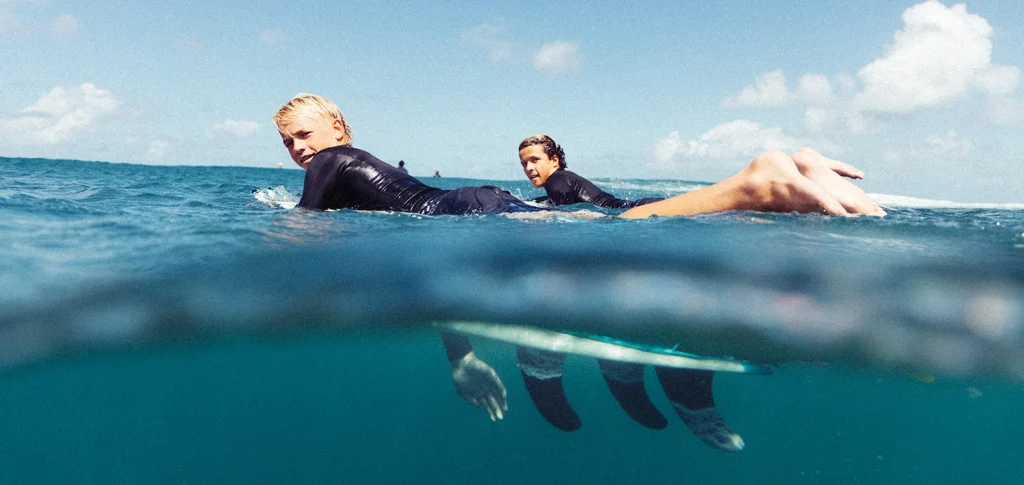
The thickness of the neoprene depends on the water temperature. For UK summer waters (15-18°C), a 3/2 mm wetsuit (3 mm on the torso, 2 mm on the arms and legs) is usually the minimum, though a 4/3 mm is often a safer bet for prolonged sessions in the UK. In colder months, opt for a 5/4 mm, boots, and a hood.
The fit requires special attention. The suit must hug the body without being too tight or too loose. Too tight, and it restricts movement; too loose, and cold water flushes through, reducing thermal efficiency. Look for back-zip models to make getting changed easier.
Essential accessories
- Leash: Connects the board to your child’s ankle to prevent it from drifting away in a fall. Choose a model adapted to the board size: too long and it tangles; too short and it restricts movement.
- Wax: Improves grip on the board. Apply it in circular motions to create bumps for traction and top it up regularly. Involve your child in this routine to develop their autonomy.
- Sun protection: Essential. Use waterproof SPF 50+ cream/stick, focusing on the face, shoulders, and tops of the feet. Full suits and rash vests also provide effective UV protection.
Organising the first session : a parent’s guide
Finding the perfect spot to learn safely
The choice of spot determines the success of the initiation. Look for beaches with consistent “whitewash” (broken waves), a sandy bottom, and a gentle slope. Waves under one metre (3ft) offer ideal learning terrain without being intimidating for beginners.
Avoid rocky areas, strong currents (rips), or spots crowded with experienced surfers. Prioritise lifeguarded beaches (look for the RNLI flags in the UK). Ask locals or surf schools about the conditions and the best zones for children.
Weather conditions significantly influence the session. A light offshore wind (land to sea) keeps waves clean, while onshore wind makes them messy. Check surf forecasts (like Magicseaweed or Surfline) and choose slots with mild conditions to maximise chances of success.
Golden rules to explain before entering the water
- Priority: Belong to the surfer closest to the peak (breaking point) of the wave. Teach your child to look around before catching a wave and to respect this fundamental rule. This notion of sharing creates the authentic surf spirit.
- Never let go of the board: A primary safety rule. In a wipeout, your child must try to maintain contact with their board or leash. A loose board becomes a dangerous projectile for others. Teach them to control their equipment in all circumstances.
“As a surf instructor, I always tell kids (and parents): talk to us! As soon as there is fatigue, a small worry, or a problem, signal it immediately. Also, set up simple visual codes to communicate from a distance, and clearly define the limits of the allowed surfing zone with your child.”
From the beach to the first whitewash
A beach warm-up prepares the body for effort and prevents injury. A few minutes of joint mobilization, light stretching, and practising the paddling motion prepare your child physically and mentally. Use this time to review safety instructions.
The prone position (lying down) is first learned on the sand. Your child must find their balance point, with hands on either side of the board at shoulder level. Repeat the paddling and pop-up movement several times before entering the water.
The first waves are caught in the whitewash (foam), near the shore. Gently push the board with your child lying on it, choosing small waves. This phase allows them to get used to the sensation of gliding and speed progressively, without the complexity of the initial take-off.
How to keep motivation high after the start?
Prioritise play to turn learning into fun
Gamify the learning process by creating fun and progressive challenges. Propose playful goals like “stay standing until the post,” “catch three waves in a row,” or “bring back a shell while surfing.” These little challenges keep engagement high while developing skills.
Vary activities to avoid monotony. Alternate between surf sessions, beach games, rock pooling, and observing marine life. This holistic approach keeps your child interested in the ocean environment beyond just surfing.
Celebrate every progression, however small. A child who stands for one extra second deserves as much praise as one who nails their first real take-off. This positive reinforcement strengthens their confidence and motivation to persevere.
Surf School : the right move for progress?
Surf schools offer a structured and safe framework for learning. Qualified instructors master pedagogy adapted for children and know local conditions perfectly. Their experience helps avoid common mistakes and accelerates progress.
Group emulation particularly motivates children. Learning alongside other youngsters of the same level creates a positive and stimulating dynamic. The friendships formed around a common passion enrich the experience and encourage perseverance.
Choose a recognised school (e.g., ISA or Surfing England accredited) with qualified instructors and adapted equipment. Check certifications, read reviews, and don’t hesitate to watch a session before signing your child up. The quality of supervision directly influences the safety and progress of your young surfer.n’hésitez pas à observer une session avant d’inscrire votre enfant. La qualité de l’encadrement influence directement la sécurité et les progrès de votre jeune surfeur.
FAQ – Your questions about kids’ surfing
At what age can a child start surfing?
Most schools accept children from 6 years old, but some can start as early as 4 or 5 if they are very comfortable in the water. Emotional maturity is more important than chronological age.
How much does beginner surf gear cost?
Budget around £130-£220 for a complete beginner kit: Foam board (£70-£110), wetsuit (£40-£90), leash (£15-£20), wax (£3-£5). Renting is always a cost-effective option to test the waters first.
How do I know if conditions are suitable for a child?
Waves under 1 metre (3ft), light wind, sandy bottom, no strong currents. Lifeguarded beaches offer a secure framework for learning.