
Surfing has a language all of its own, forged by decades of passion. From the line-up to perfect barrels, every word counts. With these 100 essential terms, you’ll better understand surfing and its culture, whether you’re riding the wave or watching from the peak.
The surfer’s gear
Understanding your equipment is step one for any surfer. Each component has its own precise terminology, developed over the years by shapers, riders, and enthusiasts.
Breaking down the surfboard
The board is the surfer’s soul. Its construction and characteristics entirely determine your experience on the water.
- Bottom: The underside of the board, sculpted with different profiles (concave, convex, flat) to optimise glide and speed.
- Rails: The side edges of the board; these are the water guides that directly influence manoeuvrability and hold in the wave face.
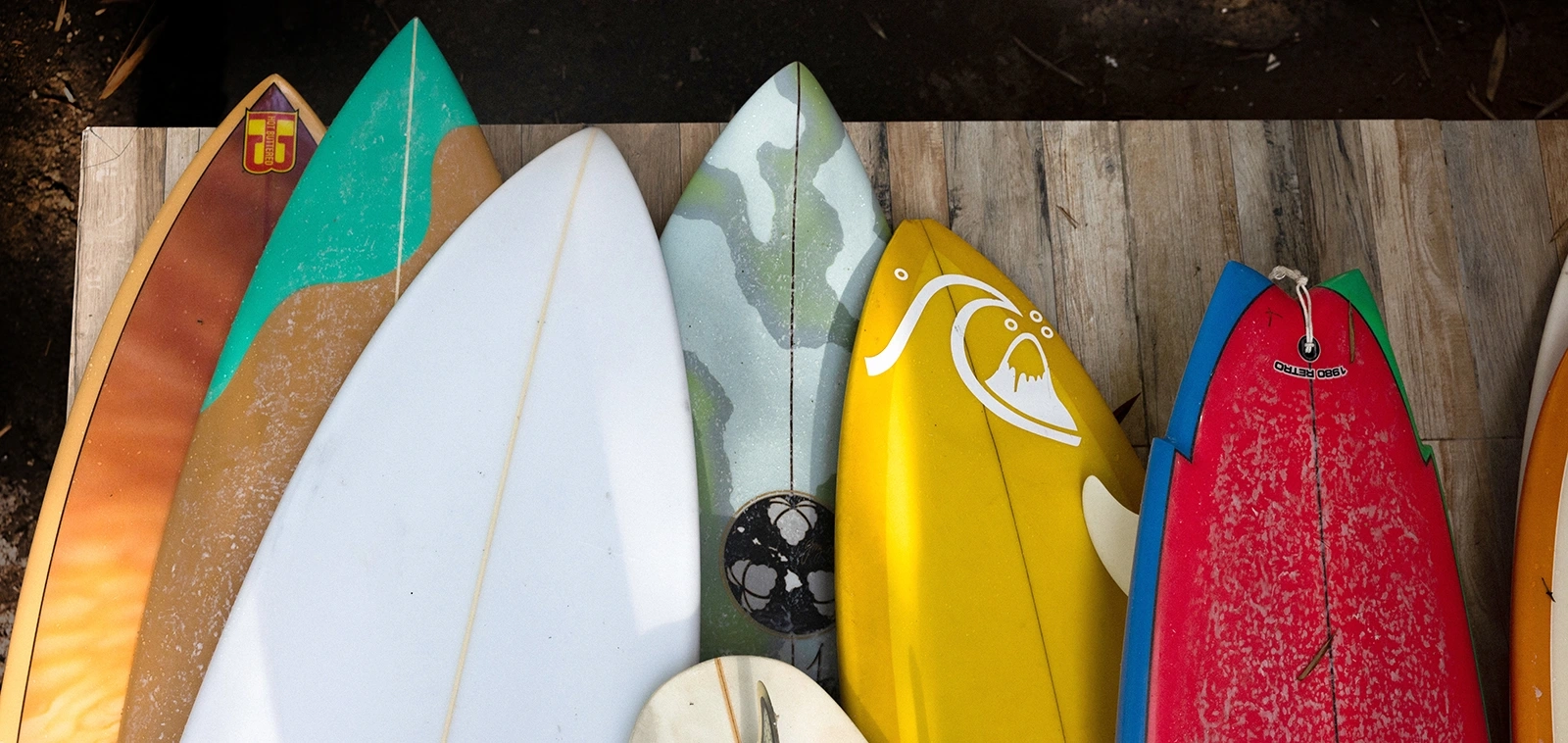
- Nose: The front tip of the board. Its shape (pointed, rounded) determines buoyancy and gliding ability in smaller conditions.
- Tail: The back of the board, available in multiple configurations (squash, pin, round) to adapt performance to specific conditions and surf styles.
- Deck: The top surface where the surfer stands, usually covered in wax to improve grip.
- Rocker: The longitudinal curve of the board (like a banana). This is a crucial element that influences paddling speed and performance in the wave.
- Foam: The core of the board, generally made of polyurethane (PU) or polystyrene (EPS), which determines volume and buoyancy.
- Stringer: The central wooden strip running down the length of the board to provide stiffness and structural strength.
- Leash plug: The attachment point located on the tail where the leash connects the surfer to their board.
Kitting up to face the waves
Beyond the board, a surfer’s kit consists of technical essentials vital for both safety and performance.
- Leash: The coiled cord connecting the surfer’s ankle to the tail of the board—an absolute safety necessity to prevent losing your board.
- Wax: Special grip wax applied to the deck to create the traction needed for foot placement and turning.
- Pad: A foam grip glued to the tail, acting as an alternative or supplement to wax to optimise back-foot traction.
- Wetsuit: The neoprene suit that maintains body temperature in cold water—vital for surfing year-round in the UK.
- Boardshorts: Technical surf shorts designed to resist chafing and offer total freedom of movement.
- Fins: The hydrofoils under the board that ensure stability, direction, and control during manoeuvres.
- Fin setup: The configuration of the fins (single, twin, thruster, quad) which completely transforms the board’s behaviour.
- Boardbag: The protective cover that keeps your board safe during transport and storage.
Understanding the ocean : reading waves and spots
The ocean has its own vocabulary, developed to accurately describe the conditions and phenomena that create perfect waves.
The different types of waves
Every wave tells the story of its formation and offers unique possibilities to surfers who know how to decipher them.
- Beach break: Waves breaking over a sandy bottom. These formations are shifting and accessible, making them perfect for beginners.
- Point break: A long wave breaking along a rocky point or headland, offering extended, regular rides for experienced surfers.
- Reef break: A wave breaking over a coral reef or rock shelf. Powerful and technical, these are often reserved for advanced riders.
- Barrel: The perfect hollow tube formed by the lip curling over—the ultimate goal for any surfer seeking the ideal ride.
- Closeout: A wave that breaks along its entire length at once, making surfing impossible or requiring a very technical exit.
- Left: A wave breaking to the surfer’s left (when facing the shore).
- Right: A wave breaking to the surfer’s right, offering specific lines and manoeuvres.
- Set: A series of larger waves that arrive in regular groups.
- Lull: The calm period between sets—a prime moment to position yourself in the line-up or paddle out.
Decoding the conditions and the spot
Reading the ocean requires a keen understanding of the elements that create surfable conditions.
- Line-up: The zone where surfers wait for waves; strategic positioning here is essential.
- Peak: The highest point where the wave begins to break; the prime spot for taking priority.
- Shoulder: The unbroken part of the wave face, the open section that allows for manoeuvres.
- White water: The white foam created by a broken wave—the training ground for beginners.
- Channel: A deeper area of water where waves don’t break, allowing you to paddle out to the line-up more easily.
- Rip current: A strong current of water pulling out to sea. Understanding this is vital for safety.
- Shore break: Waves breaking directly onto the shore. Dangerous, but sometimes surfable for experts (skimboarding territory).
- Offshore: Wind blowing from land to sea. It grooms the waves and holds them up—the ideal condition every surfer hunts for.
- Onshore: Wind blowing from sea to land. It degrades conditions, creating messy, choppy waves.
- Glassy: An ocean surface smooth as a mirror with no wind—perfect conditions for memorable sessions.
Surf manoeuvres : from basics to expert moves
The technical vocabulary of manoeuvres reveals the depth of modern surfing, from fundamental movements to the most radical tricks.
The first technical steps
Mastering basic terms allows you to understand advice and progress effectively in your learning curve.
- Paddle: The fundamental arm movement used to catch waves and move through the water.
- Take-off: The crucial moment you transition from lying prone to standing on the board.
- Pop-up: The explosive technical movement of the take-off, snapping quickly into a surf stance.
- Stance: The position of your feet on the board (Regular or Goofy)—the foundation of all movement.
- Bottom turn: The turn at the bottom of the wave that generates the speed needed to climb back up the face.
- Cutback: A foundational manoeuvre consisting of turning back towards the breaking part of the wave (the power source).
- Kick out: Exiting the wave cleanly over the back to end your ride.
- Duck dive: The technique used to dive under breaking waves with your board.
- Turtle roll: An alternative to the duck dive for high-volume boards (longboards), rolling upside down holding the rails.
Iconic moves that fuel the dream
Modern surfing constantly pushes limits with spectacular manoeuvres that seem to defy gravity.
- Carve: A powerful, elongated turn that buries the rail deep in the water—the signature of power surfing.
- Snap: A radical, explosive turn at the top of the wave, often throwing spray.
- Floater: Gliding over the breaking lip or foam section—a move often used to make a section.
- Tube riding: The art of surfing inside the barrel—the ultimate experience of connection with the wave.
- Aerial: An air manoeuvre where the surfer and board take off completely from the wave.
- 360: A full rotation on the wave face, a technical trick demanding perfect timing and balance.
- Layback: A move where the surfer leans their back towards the water, often used in the tube or during powerful turns.
- Roundhouse cutback: A figure-of-eight turn involving a cutback followed by a rebound off the foam.
- Off the lip: A vertical manoeuvre where the board hits the breaking crest before dropping back down.
Surf culture : speaking like a local
Surf culture expresses itself through unique slang—a blend of technical expressions and vibes specific to every spot.
Community expressions
Every region develops its own quirks, but this linguistic richness unites surfers globally.
- Stoked: A state of pure excitement after a memorable session or when facing perfect conditions.
- Epic: Describes exceptional conditions or an amazing session—a rare and precious moment.
- Gnarly: Describes difficult, scary, or dangerous conditions—impressive waves or technical spots.
- Rad: Cool, awesome, impressive—used to qualify a manoeuvre or a positive attitude.
- Kook: An inexperienced surfer who doesn’t respect the rules or puts others in danger (use with caution!).
- Local: A surfer who rides a specific spot regularly and knows all its secrets.
- Grom: A young, up-and-coming surfer (usually a kid) who progresses fast and is full of energy.
- Shred: To surf with an aggressive, high-performance style; to tear the wave apart.
- Stall: To slow down voluntarily (often by pressing on the tail) to let the tube cover you.
Slang to describe the vibe and people
The unique atmosphere of surfing is captured in colourful terms that describe spirit and emotion.
- Vibes: The general atmosphere of a spot or session; the collective energy.
- Aloha spirit: A mindset of respect, welcome, and sharing inherited from original Hawaiian culture.
- Dawn patrol: An early morning session at first light—a magical time favoured by the dedicated.
- Glass off: A period in the evening when the wind dies down, turning the sea to glass.
- Crowd: The number of surfers at a spot—a factor that influences the vibe and wave count.
- Localism: The sometimes excessive protection of a spot by its regulars—a controversial aspect of the culture.
- Soul surfer: A surfer who rides purely for the love of the glide, with no interest in competition or sponsorship.
- Charger: A surfer who doesn’t hesitate to take on big waves and heavy conditions.
- Waterman: A complete ocean athlete who masters all forms of water sports (surfing, paddling, diving).
- Blown out: Conditions ruined by strong wind; a compromised or cancelled session.
Mastering this lexicon will significantly enrich your surfing experience and make chats in the car park much easier. Each term carries the heritage of generations of passionate surfers who shaped this unique culture. May these words accompany you in your future sessions and help you decipher the rich universe of the waves.
FAQ – Your questions about surf vocabulary
What is the difference between a “barrel” and a “tube”?
These terms designate the exact same phenomenon: the wave curling over to create a hollow cylinder. They are interchangeable synonyms, though “barrel” is perhaps slightly more common in modern slang.
How do you distinguish a “grom” from a “kook”?
A “grom” (or grommet) is a young, talented surfer who is learning fast and generally respects the code. A “kook” is a beginner (of any age) who lacks experience, awareness, and may be dangerous due to not knowing the rules.
What does “having priority” mean in the line-up?
Priority belongs to the surfer closest to the peak (where the wave starts breaking), or the surfer who is already up and riding closest to the curl.
Why do we say “offshore” and “onshore”?
These terms describe wind direction relative to the coast. “Offshore” blows from the land off to the sea (ideal, smooth waves). “Onshore” blows from the sea on to the land (creates chop and mess).
What is the difference between “regular” and “goofy”?
These terms define your natural foot stance. “Regular” means standing with your left foot forward. “Goofy” means standing with your right foot forward. Neither is “correct”—it’s just preference!