
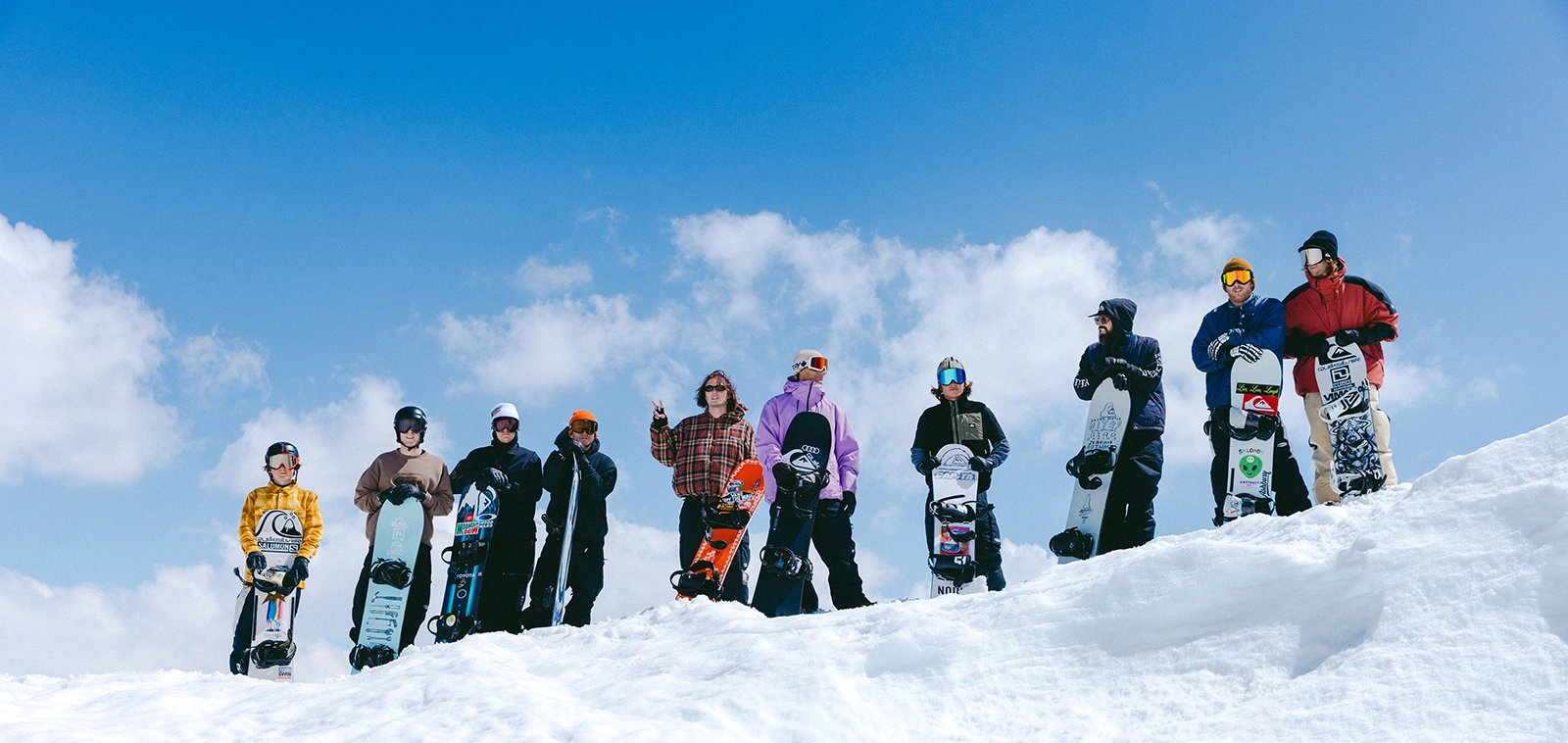
The mountain has its own language. To ride with confidence and fit right in at the après-ski, you need to master the lingo. From varying snow conditions to technical gear talk and lift-side slang, this lexicon brings together the key terms you need to decode the world of skiing and snowboarding.
Piste jargon and mountain safety
Piste jargon: The collection of technical terms and slang used across the ski area, covering everything from snow conditions to lift types.
Snow conditions: A description of the surface state (powder, slush, icy, chopped up, etc.), which directly impacts your safety, speed, and overall feel.
Safety briefing: A quick update where instructors, ski patrol, or guides explain the day’s risks (avalanches, wind slabs, visibility) and the rules to follow.
Ski patrol: The professionals responsible for mountain safety, including marking runs, controlled avalanche blasting, and mountain rescue.
Snow and avalanche report: The official daily document summarising snow depths, quality, and the local avalanche risk level.
Avalanche risk: A danger scale from 1 to 5 used to evaluate snowpack stability in a specific sector (Low, Moderate, Considerable, High, Very High).
Snow and terrain vocabulary
Understanding snow types
Powder (Pow): Fresh, light, uncompacted snow that offers a “floating” sensation. The holy grail for freeriders.
Fresh snow: Snow that has recently fallen and is usually untracked, varying in weight depending on the temperature.
Chop / Tracked-out snow: Snow that has been heavily ridden or marked by groomers, creating an uneven surface that is still relatively soft.
Piste / Groomed snow: Snow that has been compacted and smoothed by snowcats, ideal for learning, carving, and high-speed laps.
Spring snow: Snow that softens during the day due to sun exposure, often becoming heavier and wetter in the afternoon.
Slush: Very wet, heavy, and sticky snow common in late spring. It’s hard on the legs and requires strong, deliberate movements.
Heavy snow: Dense, high-moisture snow that creates drag and makes turning more difficult.
Breakable crust: Snow where the top layer has frozen over after a partial melt, forming a crust that collapses under the rider’s weight.
Corn snow: Snow that has gone through multiple freeze-thaw cycles, usually hard in the morning and perfectly soft by midday.
Wind slabs: Dangerous accumulations of snow formed by wind on certain slopes; these unstable layers can break away and trigger avalanches.
Bulletproof ice: A piste where the snow has been packed so hard it becomes a solid, slick surface, making it very difficult for edges to grip.
Identifying resort zones
Backcountry: Wild, remote areas away from the resort lifts (often reached by hiking), combining freeride elements with natural drops and vast open spaces.
Ski area / Resort: The entire network of pistes, lifts, and marked zones accessible with a lift pass.
Green run: The easiest trails with a gentle slope, reserved for beginners and those learning the basics.
Blue run: Intermediate trails, often longer or steeper than greens, suited to those who can comfortably link turns.
Red run: Advanced trails for confident skiers and snowboarders; they are steeper and more technically demanding.
Black run: The most difficult pistes, often very steep and sometimes left un-groomed (bumps), reserved for expert riders.
Nursery slopes: Dedicated beginner areas at the bottom of the resort, often featuring “magic carpets” and button lifts.
Marked itinerary: An un-groomed but marked and patrolled run, allowing riders to experience a “backcountry” feel in a safer environment.
Off-piste: Terrain located outside the marked and groomed runs. It offers freedom and powder but requires safety gear (transceiver, probe, shovel) and specialist knowledge.
Freeride zone: A specific off-piste sector, sometimes promoted by the resort, dedicated to more adventurous, “big mountain” riding.
Couloir: A narrow, often steep gully flanked by rock walls—a classic feature for extreme skiing and snowboarding.
Snowpark / Terrain park: A dedicated freestyle area with man-made features like kickers (jumps), rails, and boxes for performing tricks.
Boardercross: A purpose-built track with berms (banked turns), rollers, and jumps, used for racing or recreation.
Master the gear : a guide to ski and snowboard equipment
Decoding your ski and snowboard tech
Traditional Camber: The upward curve in the middle of a ski or board. it provides excellent edge hold, precision, and “pop” on hard-packed snow.
Rocker (Reverse Camber): The opposite of camber, where the tips are turned up. This makes turn initiation easier and helps you float in deep powder.
Hybrid Camber: A mix of traditional camber and rocker, designed to give you the best of both worlds: grip on the piste and ease in the powder.
Flex: The stiffness of the ski or board. This affects how forgiving, reactive, and stable the gear feels at high speeds.
Soft Flex: Easier to bend and more forgiving of mistakes. Ideal for beginners and freestyle riders.
Stiff Flex: Harder to bend and more demanding. It offers maximum precision and stability for experienced riders.
Waist Width: The width of the ski or board at its narrowest point. A narrower waist allows for quicker edge-to-edge transitions.
Tip (or Nose): The front end of the ski or board, designed to initiate turns and provide lift in soft snow.
Tail: The rear end of the gear, which influences how you finish a turn and provides stability during landings.
Edges: The metal strips along the sides that “bite” into the snow, allowing you to grip while turning.
Base: The underside of the gear. Usually made of P-Tex, it needs regular maintenance with wax to ensure a smooth glide.
Wax: A product applied to the base to improve speed and protect the material from the abrasive nature of the snow.
Bindings: The interface that connects your boots to your skis or board, transferring your movements directly to the snow.
Splitboard: A snowboard that splits into two halves to be used like touring skis for the ascent, then clips back together for the descent.
Understanding technical outerwear
Three-Layer System: The standard way to dress for the mountains, consisting of a base layer, a mid-layer, and an outer shell to manage heat and moisture.
Base Layer: A breathable first layer worn against the skin to wick away sweat.
Mid-Layer: The insulating layer (fleece, down jacket, or softshell) that traps body heat.
Outer Shell: Your jacket and trousers. These protect you from wind, snow, and rain thanks to a waterproof, breathable membrane.
Membrane: A technical film (like Gore-Tex) integrated into the fabric that keeps water out while allowing sweat to escape.
Waterproof Rating: Measured in millimetres (mm). It indicates the level of water pressure the fabric can withstand (e.g., 10,000mm or 20,000mm).
Breathability: The fabric’s ability to let moisture escape, usually expressed in g/m²/24h.
DWR (Durable Water Repellent): A coating on the outer fabric that causes water to bead up and roll off rather than soaking in.
Taped Seams: Waterproof tape applied over the stitching to prevent water from leaking through the needle holes.
Pit Zips / Vent Zips: Zips under the arms or on the thighs that you can open to dump heat during intense activity.
Snow Gaiters / Powder Skirt: Elasticated fabric inside the cuffs or waist to stop snow from getting inside your clothes.
Essential accessories
Ski Goggles: Vital for protecting your eyes from UV rays, wind, and the intense glare of the snow.
Photochromic Lens: A lens that automatically changes its tint depending on the light conditions (getting darker in the sun).
Polarised Lens: Filters out horizontal reflections to reduce glare and improve contrast.
Helmet: Now standard equipment for all riders to protect against head injuries.
MIPS: A technology found in high-end helmets designed to reduce rotational forces during an impact.
Back Protector: A shield worn over the spine, popular for park riding and high-speed carving.
Wrist Guards: Protective inserts often used by snowboarders to prevent fractures during a fall.
Transceiver (LVS/DVA): An electronic device worn by off-piste riders that emits or searches for a signal in the event of an avalanche.
Probe: A collapsible pole used to pinpoint a victim’s location under the snow.
Shovel: Essential for digging out anyone buried in an avalanche.
Airbag Pack: A backpack with an inflatable balloon that helps a rider stay on the surface of an avalanche.
Skins: Adhesive strips attached to the bottom of skis or a splitboard to provide grip when climbing uphill.
Freestyle tricks and techniques
Nose / Tail Press: Leaning your weight onto the front (nose) or back (tail) of the board while sliding, similar to a “manual” on a skateboard.
Freestyle: Riding focused on tricks and creativity, whether in the park or on natural “side-hits”.
Kicker: A man-made jump in the snowpark.
Table: The flat top of a jump between the take-off and the landing.
Ollie / Nollie: Jumping without a ramp by using the spring (pop) of the tail (Ollie) or the nose (Nollie).
Grab: Holding the edge of your board or skis in mid-air to add style and stability.
Method: A classic snowboard grab where the rider grabs the heel edge and arches their back for maximum style.
180 / 360: Rotations measured in degrees. A 180 means landing backwards (Switch), while a 360 is a full rotation.
Jibbing: Sliding on non-snow surfaces like rails, boxes, or logs.
Rail / Box: Obstacles in the park used for jibbing. A box is wider and more beginner-friendly than a rail.
Technical terms for freeride and carving
Regular: A riding stance with the left foot forward.
Goofy: A riding stance with the right foot forward.
Switch: Riding in the opposite direction to your natural stance (e.g., a regular rider riding goofy).
Carving: Clean turns made using only the edges of the skis or board without skidding, leaving a sharp, thin line in the snow.
Skidded turn: A turn where the skis or board slide sideways. It is more forgiving but less precise than a carved turn.
Drop: Jumping off a cliff, a cornice, or a natural ledge, usually landing on a steep slope or in deep powder.
Freeride: Riding on un-groomed terrain (fresh powder, couloirs, forests), focusing on natural lines and big turns.
Powder turn: A turn specifically for deep snow, using a smoother weight distribution and “float” to maintain a wide trajectory.
Sluff: A small, fast-moving slide of loose surface snow triggered by the rider on steep slopes. Something to watch out for in technical freeriding.
Talk like a local : essential lift jargon
- Ski lifts: The collective term for all installations (chairlifts, gondolas, drags) used to move up the mountain.
- Chairlift: An open lift where you sit on a suspended bench; the most common way to get to the top of a run.
- Gondola (or “Bubble”): An enclosed cabin suspended from a cable, offering protection from the wind and cold.
- Cable car: A large cabin capable of carrying dozens of people at once over long distances.
- Button lift (or Poma): A drag lift where a circular “button” is placed between your legs to pull you up. Often a challenge for beginners.
- Getting yanked: The often-abrupt jerk when a button lift starts, which can unbalance a rider who isn’t prepared.
- Skipping the queue: Pushing in or behaving poorly in the lift line—a major “no-no” in mountain etiquette.
- Wipeout / Stack: A heavy or spectacular fall, often resulting in a long slide down the slope on your back or front.
- Punter / Jerry: Slang terms for occasional skiers with questionable style or poorly adjusted equipment.
- Local: A rider who lives at the resort or visits so often they know every hidden spot and secret run.
Describing an epic session
Just for the stoke: The ultimate goal—riding for the pure feeling of fun and freedom, regardless of your ability level.
Pow: Short for powder; the ultimate word used to describe a day of perfect, fresh snow.
Epic / Sick / Fire: Terms used to describe conditions or a session that was absolutely perfect.
Mashed potatoes: Slang for “bouilli”—snow that is heavily transformed, wet, and exhausting to ski in.
Charging: To ride very fast and aggressively, fully committing to a line or a run.
Sending it: Going big, whether it’s hitting a massive jump, dropping a cliff, or riding a high-stakes line.
Taking a slam: Having a memorable or heavy fall that you’ll likely talk about at the bar later.
Ripping / Laying tracks: Descending quickly and cleanly, leaving behind beautiful turns or fresh lines in the powder.
All-timer session: A day on the mountain that was so good it stands out as one of the best of your life.
FAQ – Your questions about ski and snowboard lingo
Is there a big difference between ski and snowboard vocabulary?
Yes, some terms are specific (different binding types, “grabs” in snowboarding, “turn radius” in skiing), but the vast majority of terms relating to snow, safety, and technical clothing are used by both communities.
Why does mountain jargon change so often?
Because the sport is always evolving. New gear, new tricks, and the influence of social media and pro films constantly introduce new terms. Like any vibrant culture, mountain language is always growing.
How can I use this vocabulary without sounding forced?
The key is to stay authentic. It’s better to use a few terms you actually understand than to try and use every slang word on your first day. Experience on the mountain will make the language feel natural over time.