

Before you even set foot on your first board, one question arises: which foot goes in front? This decision determines your stance and directly influences your learning curve. Contrary to popular belief, there is no “right” or “wrong” stance—only the one that feels natural to you.
Why is it essential to know your stance?
Identifying your natural stance at the very beginning of your skateboarding journey is a crucial step that shapes your entire progression. This base position directly impacts your ability to stay balanced, build confidence, and navigate comfortably on your board.
Stability, balance, and progression
Your natural stance is the position in which your body feels most stable and balanced. When you adopt this posture instinctively, your muscles work optimally, and your centre of gravity finds its place naturally. This physical harmony allows you to focus on learning movements rather than struggling to stay upright.
A well-suited stance also makes it easier to acquire basic techniques: pushing with the correct foot, turning naturally, or landing tricks in a comfortable position. This initial ease creates a “virtuous circle” that significantly accelerates your progress.
Preventing bad habits
Starting with an ill-fitting stance can lead to muscular compensations and imbalances that become difficult to correct later on. These bad habits set in quickly and often require a long, tedious process to “unlearn.”
By identifying your stance from the start, you avoid these pitfalls and build a solid foundation for your future skating. This proactive approach saves you precious time and spares you unnecessary frustration.
Understanding “Stance”
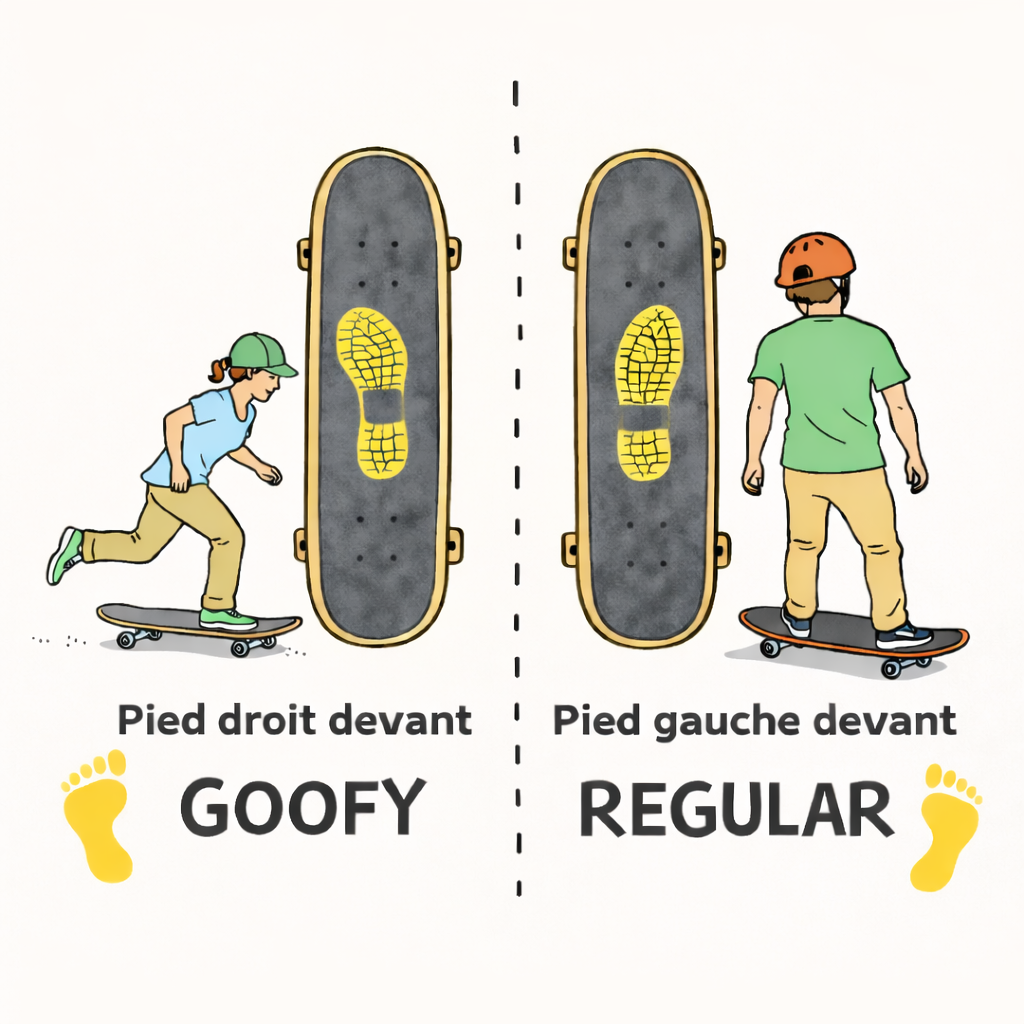
Definition of the Regular Stance (Left foot in front)
The Regular stance is characterized by placing the left foot at the front of the board, near the nose, while the right foot is positioned at the back, on the tail. In this configuration, the right foot handles the propulsion during the pushing phase. This position generally corresponds to people whose right foot is dominant for actions involving power and propulsion. Statistically, the Regular stance applies to about 60% of skaters, making it the most common position in the skating community.
Definition of the Goofy Stance (Right foot in front)
Conversely, the Goofy stance places the right foot at the front of the board and the left foot at the back. Propulsion is then carried out with the left foot, which pushes the skater forward. This position, adopted by about 40% of riders, is no less natural than the Regular stance. As a fun fact, the term “Goofy” is thought to originate from the Disney character (Dingo in French) in the 1937 film “Hawaiian Holidays,” where he is depicted surfing with his right foot forward.
Practical tests to identify your lead foot
To determine your natural stance, several simple and effective tests exist. These methods, based on your reflexes and instinctive movements, reveal your natural preference without requiring any special equipment. If you already practice other boardsports like surfing or snowboarding, you can start by trying the stance you use in those disciplines.
Just Skate: The simplest way is to get on the board (feet over the bolts) on a slight downward slope and roll gently in one direction, then try the other way. If it’s your first attempt, don’t hesitate to ask for help to avoid an unnecessary fall. After several tries, choose the direction in which you feel most comfortable.
The Slide Test: Let Instinct Speak This test reproduces the gliding sensation of skateboarding and naturally reveals your preferred stance. It is one of the most reliable methods for identifying your natural position.
- How to perform the test safely : Find a smooth surface such as polished floorboards, tiles, or lino. Put on socks to make sliding easier and stand with your feet together.
- Ask someone to give you a light push in the back, without telling you exactly when. By reflex, you will step forward with one foot to regain your balance and slide naturally. The foot you instinctively place forward corresponds to your natural front foot in skateboarding.
- Repeat this test several times to confirm the result. If you consistently put the same foot forward, you have identified your stance: Left foot forward = Regular, Right foot forward = Goofy.
The Push Test This method directly simulates the propulsion movement used in skateboarding and is an excellent indicator of your natural stance.
- Get help for a reliable result : Stand facing a friend or family member. Place your hands on their shoulders as if you were going to push them forward.
- Without thinking, perform a natural pushing motion. Observe which foot you spontaneously place forward to gain leverage and generate force. This lead foot corresponds to your natural position on the skateboard.
- The foot that remains behind to provide stability during the push will logically be the one you use to propel (push) your board. This direct correlation makes this test very revealing.
The Stairs Test This test relies on a movement we perform daily without thinking, thus revealing our natural handedness (or “footedness”).
- Identify your driving foot unconsciously : Approach a flight of stairs or a single step. Without consciously thinking about your movement, walk up the first step naturally.
- Observe which foot you lift first to begin the climb. This foot, which initiates the movement and provides the upward propulsion, generally corresponds to your back foot in skateboarding.
- By deduction, the other foot becomes your natural front foot. If you lift your right foot first, you are likely Regular (left foot forward). If your left foot goes up first, you are probably Goofy (right foot forward).
I’ve found my stance, now what?
Once you have identified your stance, it’s time to adapt. Start while stationary: place your front foot just behind the front bolts, aligned with the board, and keep the other foot on the ground to stabilize your balance. Alternate a few times, then gradually bring both feet onto the board, using a wall or a railing for support if needed.
Also, think about your upper body: your shoulders should remain mostly parallel to the board, facing the direction of travel. Avoid “twisting” your torso too much (too closed or too open): a slight opening towards the front is natural, but excessive rotation will cause you to lose control.
What if I’m neither goofy nor regular?
Some skaters do not find a marked preference after the initial tests. This situation, while less common, is perfectly normal and can even reveal interesting adaptive abilities.
Testing both positions to find your comfort If the tests do not give a clear result, the solution is to practically experiment with both stances on your board. This hands-on approach allows you to directly feel the differences and identify your preference.
During this testing phase, focus on feelings of comfort, balance, and confidence. The stance that most naturally provides these positive sensations is likely your ideal position.
Give each stance at least a week before drawing conclusions. This adaptation period allows your body to get used to the new position and develop the necessary reflexes.
FAQ – Your questions about stance
Can I change stance after I’ve started learning?
Yes, but it takes time and patience. The longer you wait, the harder the transition will be. If you feel persistent discomfort with your current stance, don’t hesitate to try the alternative.
Does stance influence which tricks I should learn?
Not directly. All tricks can be performed in both stances, but some may feel more natural depending on your position. The important thing is to stay consistent with your main stance.
Should I learn “switch” from the beginning?
No, focus first on mastering your natural stance. Switch is generally learned after acquiring a solid foundation in your primary position.
Can my stance differ between skateboarding and other boardsports?
It’s possible. Some people are Regular in skating and Goofy in surfing, or vice-versa. Every sport has its specificities; test each discipline to find your optimal comfort.