
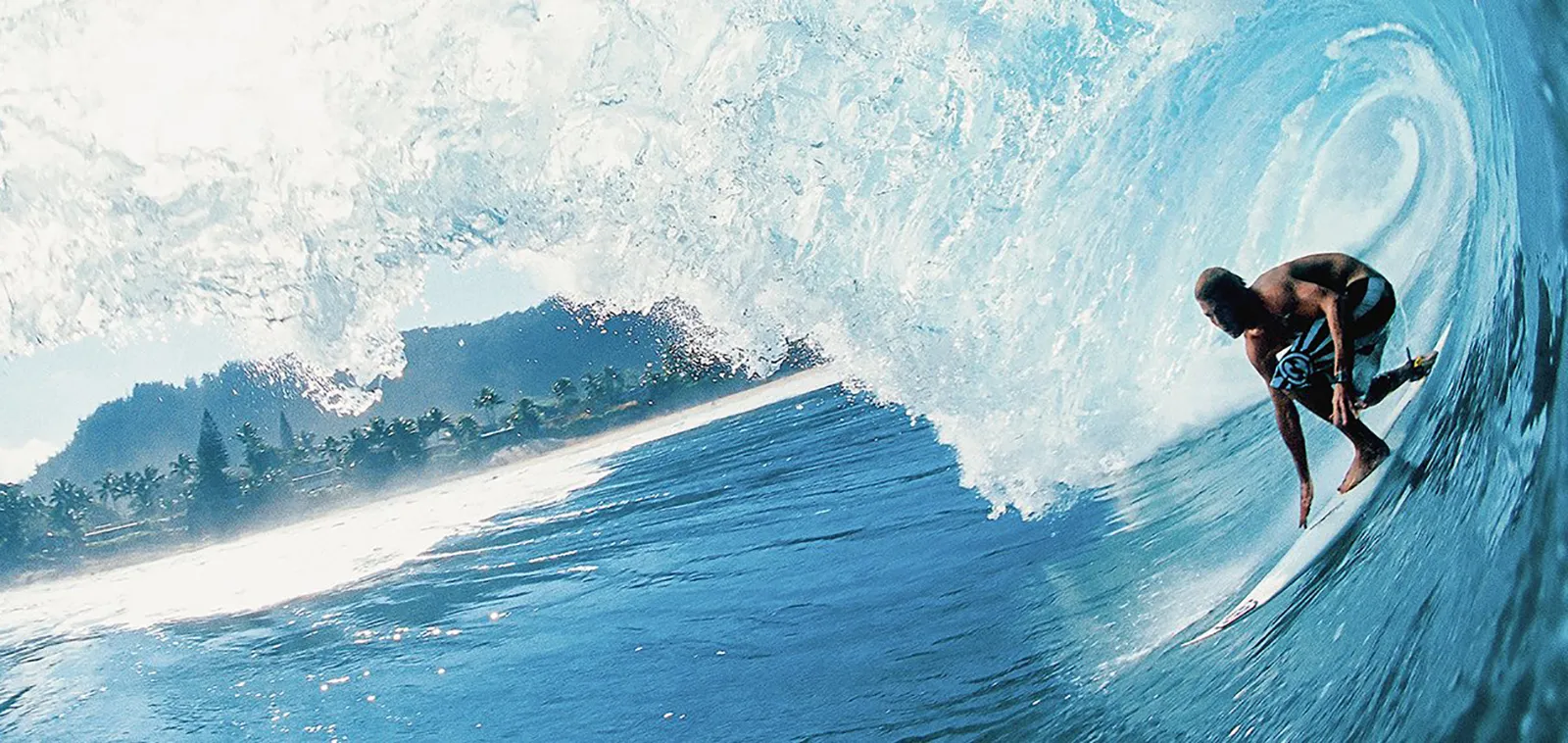
Born and raised on Kauai, Andy Irons disrupted California’s dominance of the Championship Tour in the early 2000s. Blending traditional Hawaiian power surfing with an aggressive modern approach, he helped redefine what elite-level performance surfing could look like.
The Pipeline line-up is firing that morning in 2002. Deep inside the heavy barrels of the North Shore, a goofy-footer with an unmistakable style seems to bend the laws of physics. Andy Irons does not simply surf the wave. He attacks it, unleashing the kind of raw energy that made the surfing world stop and watch. Across his boardshorts, a blood-red sunburst seems to mirror that intensity. It became one of those images that sticks: a rebellious champion who helped reshape modern surfing through both his natural talent and the unmistakable Rising Sun boardshort that became almost inseparable from him.
Who was Andy Irons, surfing’s rebellious icon?
Andy Irons was never just another surfer. Born in Lihue on the Hawaiian island of Kauai in 1978, he grew up with the kind of competitive fire that would eventually define his career. While the Tour had its polished Californian stars, Andy cultivated something very different: a raw, unapologetic image rooted in the islands, with local sessions carrying more weight than industry events.
His surfing reflected it. Where others appeared to calculate their manoeuvres, Andy often seemed to work on instinct. His cutbacks hit like punches. His airs felt explosive. There was power in everything he did, but also an unmistakable creativity. That approach had been forged on Kauai’s reefs and powerful waves, far removed from the perfect Californian beach breaks that shaped many of his rivals. Andy was also a complex character. Moments of pure joy could sit alongside much darker periods, creating a personality every bit as unpredictable as his surfing. His character was deeply connected to Hawaiian culture, where respect is earned in the water and authenticity matters.
That same duality ran through his career: capable of brilliance and chaos, always compelling, never easy to define.
Raw talent, world titles and a place at the top
The three world titles that changed surfing
Between 2002 and 2004, Andy Irons took control of the World Championship Tour. Three consecutive world titles placed him firmly among the defining surfers of his generation. They were the result of a relentless competitive drive and a style the Tour had rarely seen before. His first title in 2002 sent a shockwave through professional surfing. Andy arrived with his own formula, combining traditional Hawaiian power surfing with the increasingly progressive aerial manoeuvres of modern competition. His victory at Teahupoo that year became one of the defining moments of the season, with Irons looking completely at home in the kind of heavy waves that demanded total commitment. The titles that followed in 2003 and 2004 proved it was no one-off. Andy had learned how to win consistently on Tour without sacrificing the spontaneity that made him so dangerous.
His rivals knew that any heat could change in seconds. Give Andy a wave with potential, and he could produce something extraordinary.
Powerful, radical and impossible to imitate
Irons was never the product of a carefully manufactured marketing formula. By the time he had claimed three consecutive world crowns, his surfing was built around full commitment in the pocket and an exceptional ability to read what a wave was about to do. Heavy rail work, huge cutbacks and a vertical approach to critical sections defined his style. He constantly pushed the limits without sacrificing what made his surfing his own.
He was equally reluctant to reshape that style simply to fit judging criteria. As he put it:
« I try to change my surfing, which is the worst thing you can do. Everyone surfs their own way. If I try to surf like somebody else, I look like an idiot. ».
That refusal to conform became one of the ingredients in his historic rivalry with Kelly Slater: the Floridian’s calculated precision against the Hawaiian’s instinctive approach.
« I surf because it keeps my life in balance. Without it, I would fall into the void. »
Slater vs Irons: the rivalry that defined a generation
Few rivalries shaped 2000s surfing quite like Kelly Slater versus Andy Irons. They represented two radically different approaches to high-performance surfing.
On one side stood the calculated genius from Florida: technically immaculate, strategic and seemingly able to break competitive surfing down to a science.
On the other was the instinctive Hawaiian: emotional, explosive and driven by something that felt far less predictable.
Whenever they met in a heat, that contrast became impossible to ignore. Their rivalry went beyond results. It tapped into a much wider debate about where professional surfing was heading. Andy became associated with a rawer expression of Hawaiian surf culture, while Kelly embodied the increasingly global and professional face of the sport. Tense interviews, charged celebrations and the sheer intensity of their contests only added to the story. Even their sponsors reflected that opposition. Slater represented the global power of Quiksilver, while Irons embodied the more visceral, uncompromising image of Billabong. Two major surf brands, two champions and two very different ways of occupying the centre of the surfing world. The paradox is that each made the other better. Slater had to respond to Andy’s unpredictability and aggression. Andy, in turn, learned to channel that intensity to compete with Slater’s extraordinary consistency.
Together, they raised the standard of professional surfing.
The Rising Sun: much more than a boardshort
A design that became a symbol
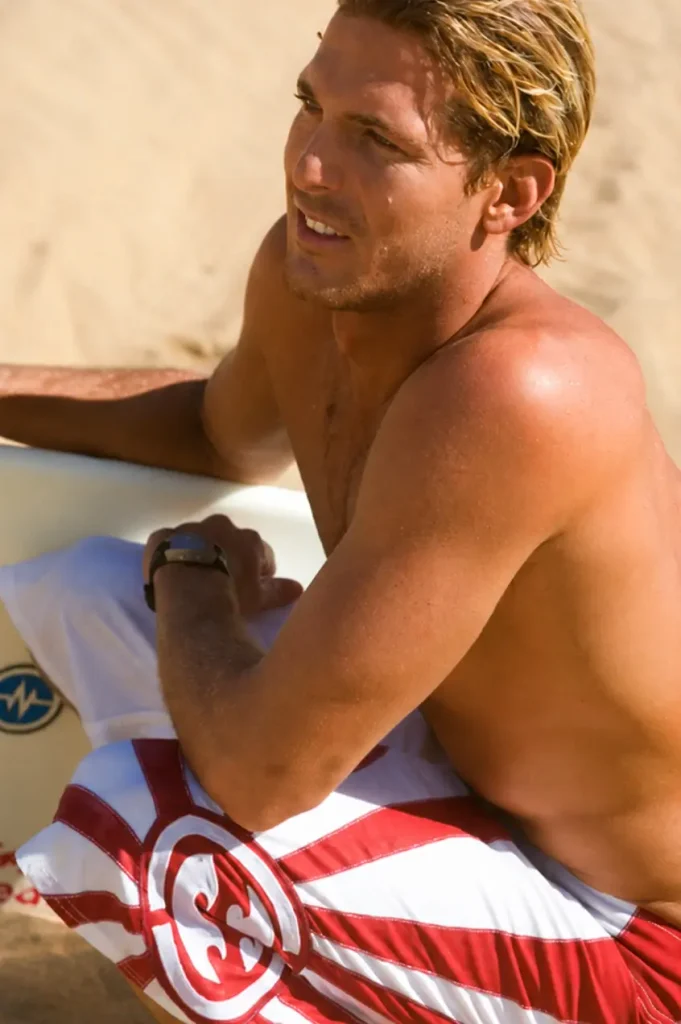
Andy Irons’ Rising Sun boardshort was never just another pair of surf shorts.
With its striking red-and-yellow sunburst graphic, the design became one of the most recognisable pieces of surfwear of its era. Its visual identity seemed perfectly matched to Irons himself: loud, energetic and impossible to ignore.
The central graphic drew on the visual codes of the Japanese rising sun, reworked through a surf aesthetic that brought together heritage and modern design. Deep reds, vivid orange and electric yellow created a feeling of constant movement – exactly the kind of visual energy associated with Andy’s surfing. Technically, the boardshort incorporated the innovations of its era:
- an ergonomic cut designed to allow freedom of movement;
- quick-drying fabric;
- reinforced seams built to withstand intensive surfing.
But it was the visual impact that really made it memorable.
Wearing the Rising Sun was a statement. It represented a certain idea of surfing: rawer, more radical and unwilling to compromise. Before long, the boardshort had become a symbol for surfers who identified with that same attitude.
How one boardshort captured the spirit of an era
The 2000s marked a turning point for surf culture.
The industry was growing rapidly, marketing budgets were expanding and surfing was becoming more global than ever. Yet at the same time, the desire for authenticity only seemed to grow stronger. The Rising Sun boardshort captured that contradiction perfectly. Andy wore it almost like armour. Through victories and defeats, the graphic became so closely associated with him that the two were difficult to separate. Its influence soon stretched well beyond professional surfing. A generation of younger surfers wanted “Andy’s shorts”, helping bold graphics and statement prints become an even bigger part of boardshort design. Today, original Rising Sun pieces have taken on the status of collectors’ items, a reminder of the lasting impact one piece of surfwear can have when it becomes connected to the right surfer at the right moment in time.
A flame that still burns
Andy Irons’ premature death in 2010 brought his career to an abrupt end, but his influence remains deeply woven into modern surfing.
Look at surfers such as John John Florence, Italo Ferreira or Gabriel Medina and it is easy to recognise elements of the radical approach Andy helped bring to the forefront of competition. His technical legacy lives on in the way modern performance surfing combines instinct, commitment and raw power. Young professionals still study his footage, analysing his lines and trying to understand the qualities that made his surfing so distinctive.
But Andy’s legacy was never purely technical.
He also reminded the surf world of the value of holding onto your identity as the sport became increasingly commercial and professionalised. That message still resonates with new generations looking for their own balance between performance, personality and authenticity. The Rising Sun boardshort continues to carry some of that spirit too. Through reissues and references to the original design, the graphic remains connected to a particular era and a particular idea of surfing: passionate, uncompromising and unmistakably individual. Andy Irons’ story is a reminder that true legends are not built on results alone. They emerge from that rare combination of extraordinary talent and a personality powerful enough to make every performance feel like more than competition.
Andy had that ability. For him, surfing was never simply a sport. It was a way of life.
FAQ : Andy Irons and his legacy
How many world titles did Andy Irons win?
Andy Irons won three consecutive world surfing titles between 2002 and 2004, establishing himself as one of the dominant competitive surfers of the era.
Where can you still find the original Rising Sun boardshort?
Original versions are now mainly found on specialist second-hand platforms or through private collectors. Limited reissues of the design may also occasionally appear.
What made Andy Irons’ surfing style so distinctive?
Andy combinait la puissance du surf traditionnel hawaïen avec des manœuvres aériennes modernes, créant un style unique mêlant technique raffinée et émotion brute, particulièrement visible dans ses backhand attacks.
How did the Kelly Slater and Andy Irons rivalry influence surfing?
Their rivalry pushed both surfers to raise their level, lifted the overall standard of the professional Tour and came to represent two contrasting approaches to competition: technical precision on one side and instinctive, emotionally charged surfing on the other.